


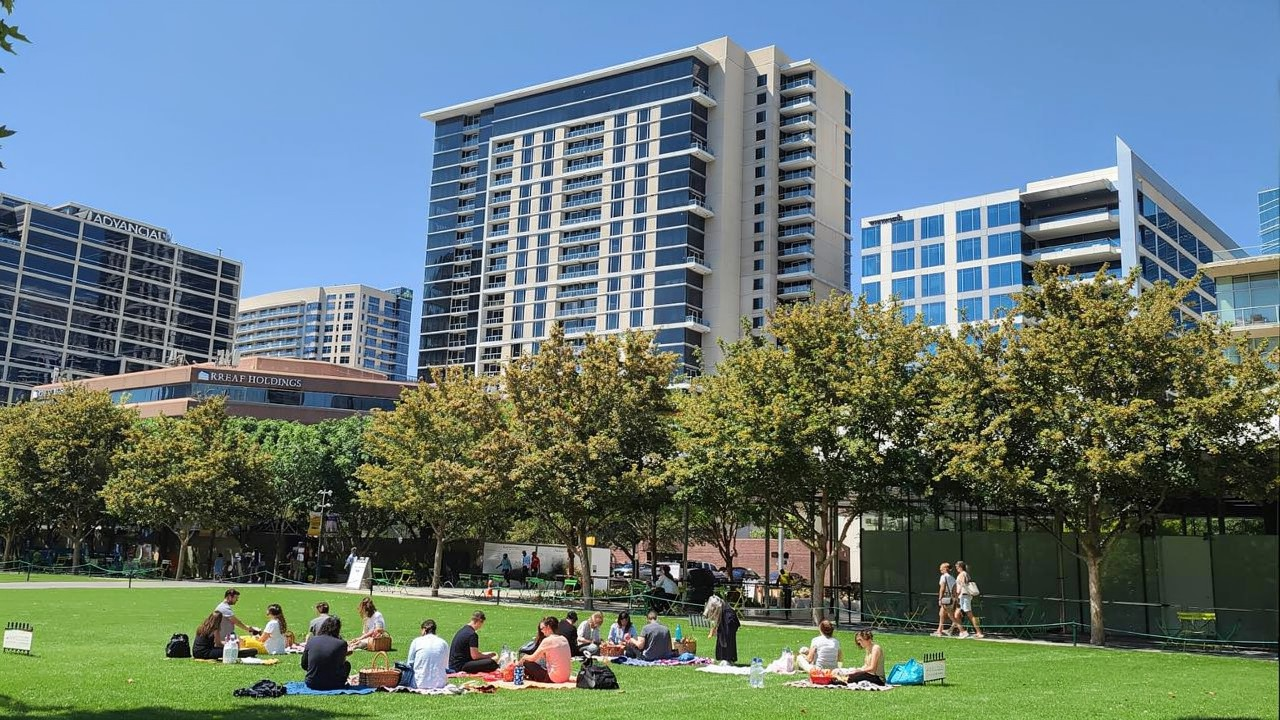
Uptown Dallas sits just north of downtown between the Katy Trail and Cedar Springs Road roughly centered around McKinney Avenue. The boundaries are loose depending on who you ask but the energy is unmistakable the moment you step off the Mckinney Avenue Trolley or park your car and realize you probably will not need it again for the rest of the day.
What Makes Uptown Different
The neighborhood is dense in a way that does not feel claustrophobic. Restaurants, boutiques, coffee shops, bars, gyms and salons stack up along McKinney Avenue and the surrounding streets in a way that rewards living without a car for a few hours. The McKinney Avenue Trolley known locally as the M-Line runs free of charge along McKinney and connects to the Arts District at the southern end. It runs seven days a week and has been doing so since 1989. That alone puts Uptown in a category of its own inside a city that barely has functional public transit.
The Katy Trail adds another layer entirely. The trail is an 11 mile paved urban greenway that runs from Reverchon Park near Uptown all the way to Kiest Park in Oak Cliff. The Uptown trailhead near Turtle Creek is where the energy is thickest especially on weekend mornings when the joggers and dog walkers outnumber the cars trying to find parking. It is free to access and open daily from 5 am to midnight.
Coordinates
The heart of Uptown is along McKinney Avenue between Allen Street and Lemmon Avenue. If you are coming from downtown Dallas you are looking at about a 10 minute drive or a 25 minute walk. From the Tollway you can exit at Lemmon Ave and be in the middle of things in under five minutes.
Parking in Uptown requires a plan. Street parking exists but fills up fast on weeknights and weekends. The most reliable paid lots are along Boll Street and near the Whole Foods on McKinney. Rates at surface lots and garages typically run between $5 and $15 depending on the evening. Ride share is genuinely the better call if you plan on being out past 9 pm.
The Cost of Uptown Living
Apartments in Uptown do not come cheap. One bedroom units in newer high rise buildings along McKinney and Routh Street typically start around $1,800 per month and climb past $3,500 for larger spaces with skyline views. Studio apartments in older walk up buildings can occasionally be found in the $1,400 to $1,600 range but those move fast. For people who prioritize walkability and being close to the action the premium makes sense on paper even if it stings at lease renewal time.
The neighborhood is also home to some of the most consistent day to day spending in Dallas. A coffee at one of the independent cafes along McKinney usually runs $6 to $8. A casual dinner at one of the sit down spots on the avenue averages $25 to $40 per person before drinks. This is not a budget neighborhood but it does not pretend to be.
Impression
Beyond the lifestyle angle Uptown has practical anchors that keep the foot traffic consistent. The Whole Foods on McKinney is a genuine gathering place. The West Village shopping area just east of McKinney near Cole Avenue draws steady foot traffic on weekends with its mix of local retailers, boutiques, and restaurants that fill up without a reservation. The Katy Trail Ice House sits directly on the trail and functions as a de facto community hub where cyclists and walkers stop in for a beer without ever getting in a car. Knox-Henderson is close enough that locals treat the two neighborhoods as one extended stretch and bounce between them depending on the night.
The dining scene in Uptown skews toward sit down spots with full bars rather than quick bites. Neighborhood staples like Neighborhood Services on McKinney have been filling up on weeknights for years. Mercat Bistro on Oak Grove and Truluck’s near West Village pull consistent crowds that do not require a special occasion. For a lower key night Cane Rosso on Fitzhugh handles the pizza crowd and Social House on McKinney remains a reliable go to for drinks without the full dinner production. Uptown also has a higher than average density of fitness studios and boutique gyms, which is not incidental. The neighborhood attracts a demographic that treats a Saturday morning workout followed by brunch as a recurring event rather than an occasional thing.
Who Lives in Uptown and Why They Stay
Uptown draws a younger professional crowd more than any other inner Dallas neighborhood. The combination of walkability, nightlife, and proximity to major employment corridors in downtown and the Turtle Creek business district makes it a natural first landing spot for people relocating to Dallas from cities like Austin, Chicago, or New York. What surprises many of them is that they stay. The assumption going in is usually that Uptown is a temporary situation before buying a house in the suburbs. Instead a meaningful number of residents push past that moment and either commit to condo ownership in the neighborhood or keep renewing because nothing else in the city compares for day to day convenience.
The dog population in Uptown is worth noting. The neighborhood is one of the most dog dense in Dallas and that shapes the culture in practical ways. The trail, the pet friendly patios on McKinney, and the general tolerance for having a dog in most social situations makes it a neighborhood where owning a dog is not an inconvenience but a social asset. Canine-friendly patios along McKinney fill up on Sunday afternoons with a combination of first dates and long established friend groups and the line between the two is not always clear.
The Honest Trade-offs
Uptown is not without its friction points. The weekend nightlife crowd that descends on McKinney Avenue between Thursday and Saturday nights brings noise, Uber gridlock, and the general chaos that comes with a high volume bar district operating at capacity. Residents on or near McKinney between Cole and Lemmon learn quickly that their Friday and Saturday nights are negotiated against the entertainment calendar whether they like it or not. The parking situation borders on broken during peak hours and surface lot pricing tends to surge without notice on event nights near the downtown core. Construction has also been a near-permanent feature of the neighborhood for the better part of a decade as new towers keep rising to meet demand that does not appear to be slowing down.
None of that seems to be stopping anyone. Uptown remains one of the most consistently in demand neighborhoods in Dallas not because it is perfect but because it delivers something the rest of the city almost never does: the ability to leave your car parked for an entire weekend and still have a full life within walking distance. In a city built around the freeway that is not a small thing. The people who have figured that out already know it. Everyone else is still catching up.

